✨Stars — Indicate the difficulty level of the book content.
★☆☆ 1 Star: Easy to read and understand.
★★☆ 2 Stars: Moderate difficulty with some specialized terms.
★★★ 3 Stars: Advanced content with complex ideas and terminology.
About the Book
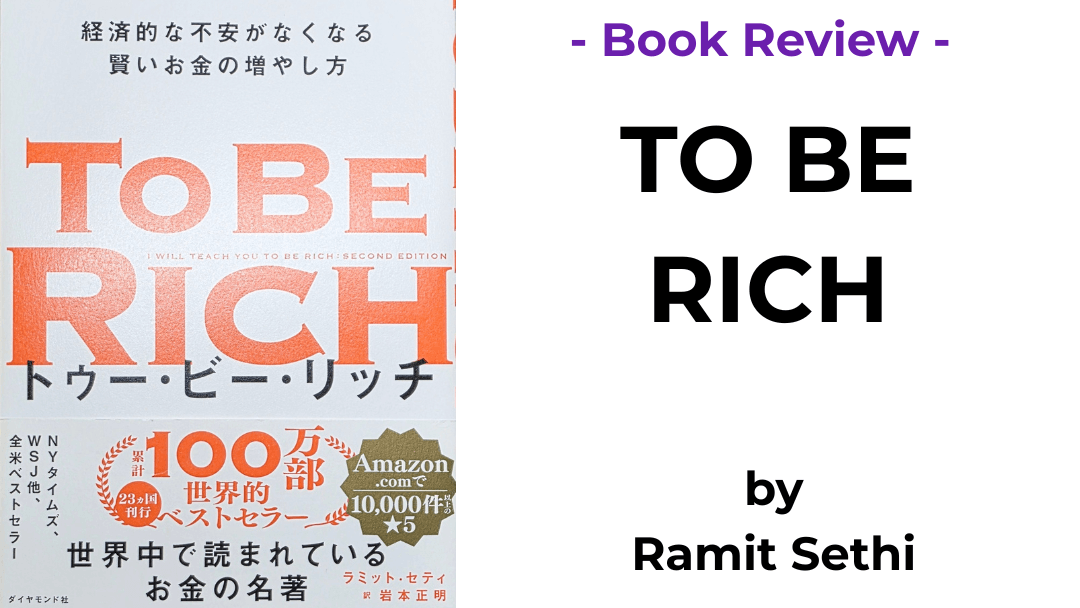
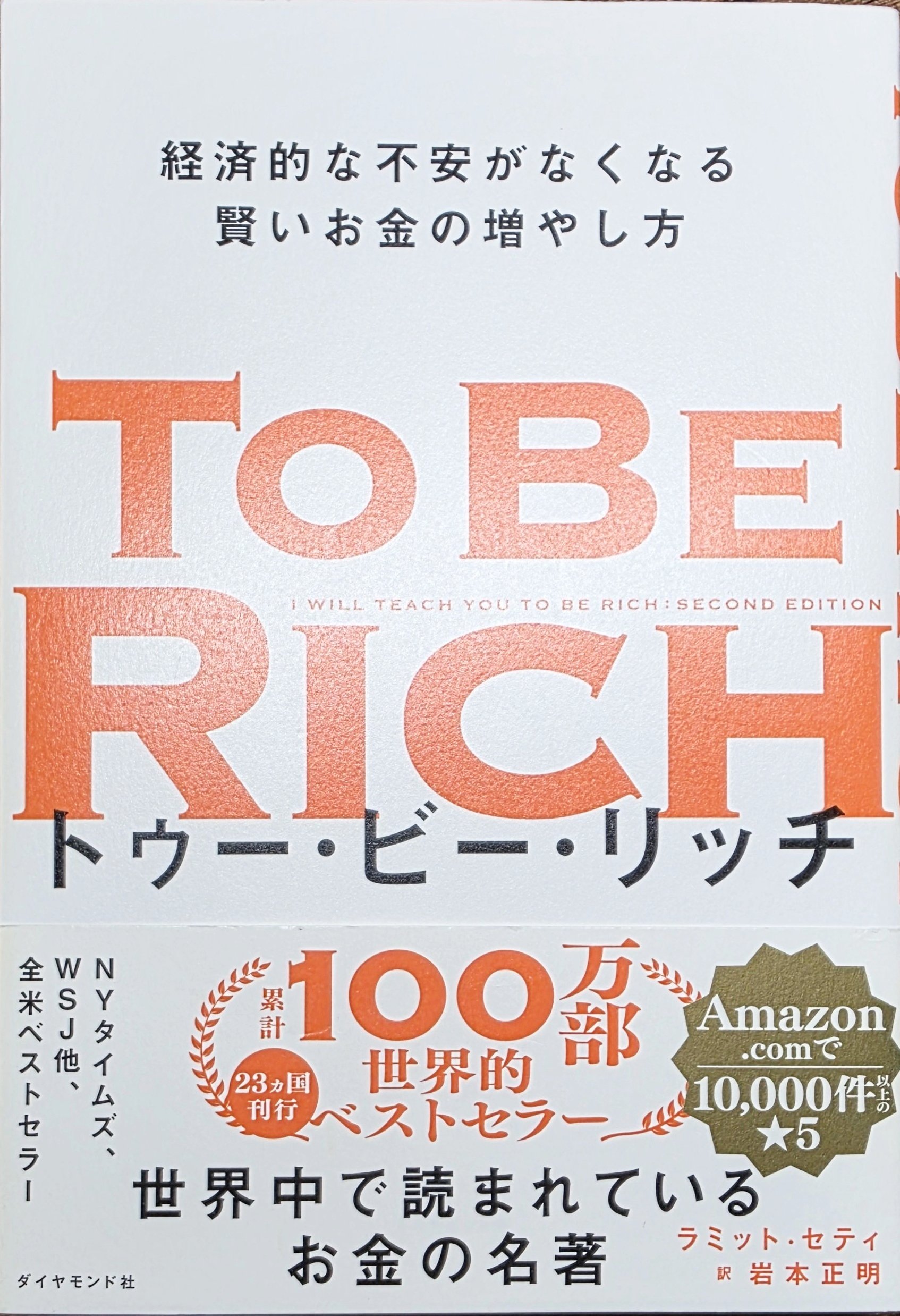
■Title: To Be Rich (トゥー・ビー・リッチ)
■Author: Ramit Sethi (ラミット・セティ)
■Publisher: Diamond, Inc. (ダイヤモンド社)
To Be Rich, published in Japan, is the Japanese edition of I Will Teach You to Be Rich, written by Ramit Sethi.
Ramit Sethi is an American author and entrepreneur from California. He studied Science, Technology, and Society at Stanford University with a minor in Psychology, and later earned a master’s degree in sociology, focusing on social psychology, from the same university.
I Will Teach You to Be Rich, published in 2009, became a bestseller on both The New York Times and The Wall Street Journal bestseller lists. The book introduces methods for automating personal finances and managing money in line with one’s values, and has sold more than one million copies across 23 countries.
Summary
The book explains that there is no special secret to becoming rich. Instead, it states that by consistently building small habits and maintaining a certain level of discipline, it is possible to grow wealth with relatively little effort. It emphasizes that learning how to take action is more important than acquiring specialized knowledge in finance or investing.
The author recommends using credit cards wisely by optimizing them rather than using them without consideration. He also advises opening a brokerage account and starting to invest, even with a small amount such as a few thousand yen. To do so, readers are encouraged to rethink their existing attitudes toward money. The book introduces the idea of building an automated system that allows money to grow even while one is asleep.
The book also explains why advice from financial experts is often not helpful for individuals. In addition, it introduces various financial products, including target-date funds, which allow people to start investing easily with small amounts. Finally, it explains how to adjust an investment portfolio for asset management and discusses how to approach major life events such as relationships, marriage, and homeownership in a financially stable manner.
Notable Quotes
■リッチな生活の10のルール
「1」リッチな生活は、好きではないものへの支出を容赦なく抑えることで、好きなものに惜しみなくお金を使える暮らしのことだ。
「4」支出を抑えるには限度があるが、いくら稼ぐかには上限がない。
「8」舵取りをするのはあなただ。これはディズニー映画ではない。誰も助けに来てくれない。
■Ten Rules for a Rich Life
「1」A rich life means cutting spending mercilessly on things you do not care about, so that you can spend generously on the things you truly love.
「4」There is a limit to how much you can cut expenses, but there is no limit to how much you can earn.
「8」You are the one at the helm. This is not a Disney movie. No one is coming to save you.
■お金には存在する理由がある。あなたがやりたいことをやるためだ。確かに、今稼いでいるお金を使わずに投資に回せば、将来もっと大きな価値になる。ただ、明日のためだけに今を犠牲にするのは、正しい生き方ではない。ほとんどの人が見落としているある投資がある。それは自分自身への投資だ。
Money has a reason for existing. It exists to allow you to do what you want to do. It is true that if you invest the money you earn now instead of spending it, it can become something of greater value in the future. However, sacrificing the present solely for the sake of tomorrow is not the right way to live. There is one type of investment that most people overlook. That investment is investing in yourself.
My Thoughts
Many people may believe that there must be some special reason why people become rich. However, the author explains that there is no special secret to becoming wealthy, and even suggests that it is possible to become rich with relatively little effort.
One of the most interesting parts of this book is the comparison between dieting and personal finance. When people do not accurately track their calorie intake while dieting, they often end up eating far more than they realize. The same applies to personal finance: if expenses are not properly tracked, people tend to spend much more money than they think they do. The author also points out that focusing excessively on details such as calories, meals, and exercise in dieting is similar to obsessing over interest rates or popular individual stocks in finance. Another shared trait is that people tend to trust advice from the media or those around them more than actual research results or well-established books. Through this comparison, it becomes clearer what the author consistently emphasizes throughout the book.
The definition of a rich life presented in the book was also deeply impressive. A rich life is described as one in which spending is reduced on things one does not like, while money is spent freely on things one truly values. This does not mean spending money indiscriminately, but rather being able to spend as much as one wants on the things one chooses. In that sense, this definition feels closer to freedom of choice than simply to wealth.
The statement that there is a limit to how much expenses can be reduced, but no limit to how much income can be earned, has remained one of my guiding principles in life. Although I also invest in areas such as stocks, the book reminded me once again that the most important investments are ultimately in oneself and in one’s time. Rather than merely listing conventional financial knowledge, this book explains ideas—some of which may seem obvious yet are often overlooked—in a way that is closely connected to everyday life.
– Recommended Reading –

Amazon Japan To Be Rich
Comments