
✨Stars — Indicate the difficulty level of the book content.
★☆☆ 1 Star: Easy to read and understand.
★★☆ 2 Stars: Moderate difficulty with some specialized terms.
★★★ 3 Stars: Advanced content with complex ideas and terminology.
About the Book
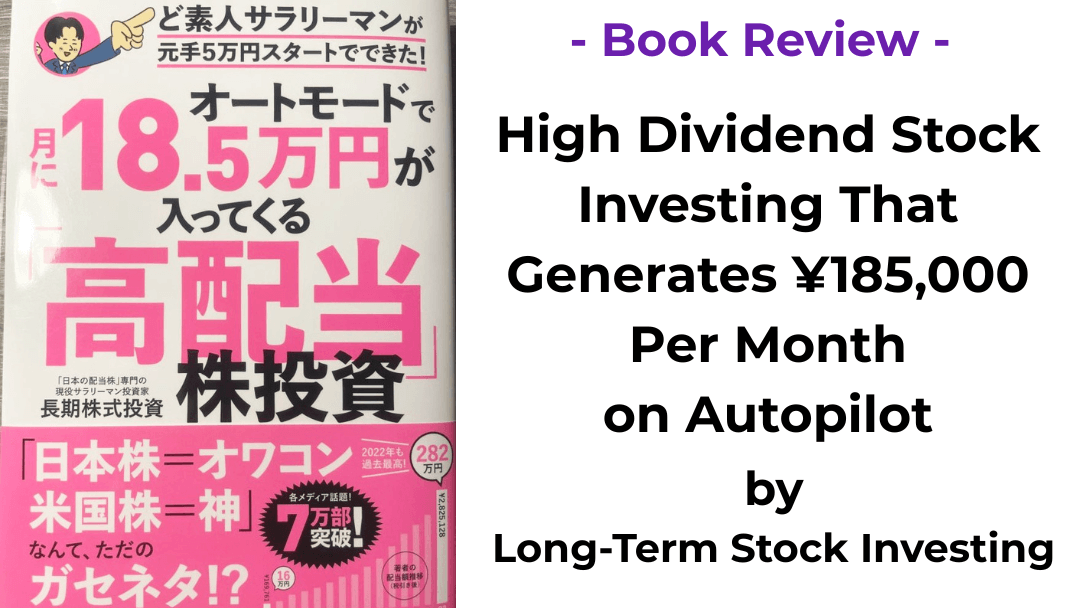
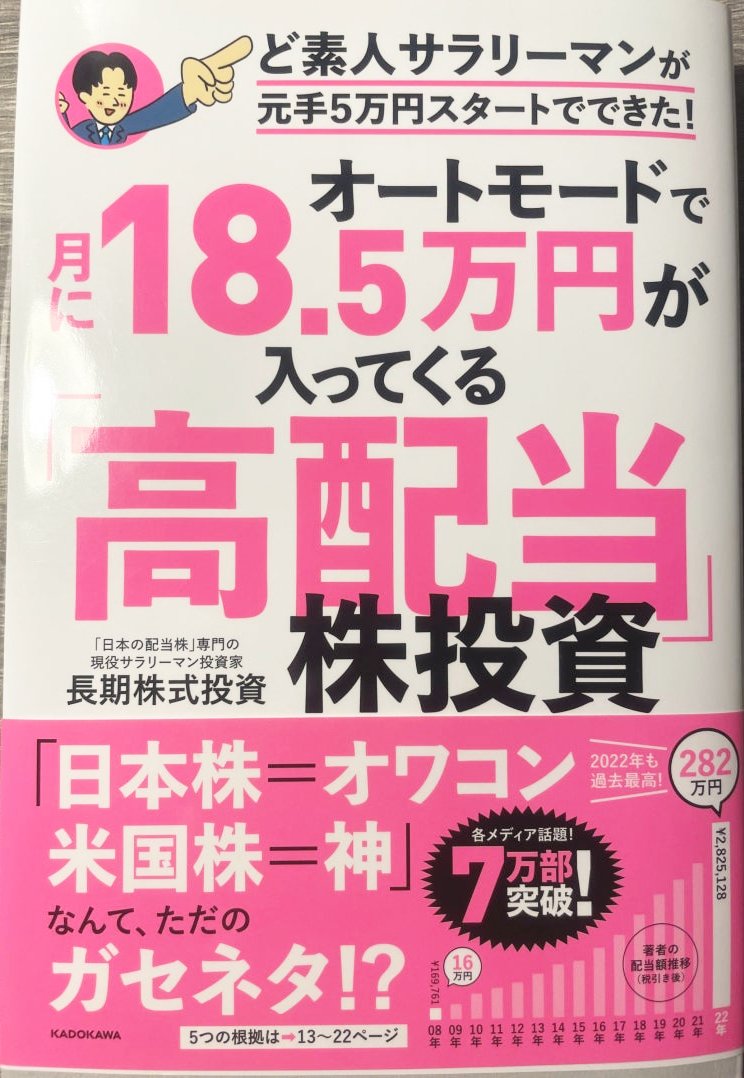
■Title: High Dividend Stock Investing That Generates ¥185,000 Per Month on Autopilot (オートモードで月に18.5万円が入ってくる「高配当」株投資)
■Author: Long-Term Stock Investing (長期株式投資)
■Publisher: KADOKAWA
The author of this book, “Long-Term Stock Investing,” is an ordinary office worker who has been steadily investing in stocks since 2004. Through years of experiencing market ups and downs, he built a dividend portfolio that grew to the point where, in 2021, his after-tax dividend income averaged about ¥185,000 per month. He explains that the greatest appeal of dividend income is that it provides a steady stream of automatic earnings independent of time and labor, and that for a regular salaried worker, ¥185,000 a month is a highly reassuring source of financial stability.
Many readers ask whether such results were possible because he had a special talent, but his answer is surprisingly simple. He says that all you need is elementary-school-level arithmetic skills and a bit of patience, not any particular talent. In fact, despite often returning home after 9 p.m. due to his busy job, he managed to build an automatic-income structure without spending much time.
Based on this experience, the book focuses on realistic long-term high-dividend investing strategies that ordinary office workers can put into practice. The content is approachable even for beginners, making it a useful guide for those newly interested in dividend investing.
Summary
This book draws on the author’s 18 years of experience in the stock market—through both rises and crashes—to explain step by step how ordinary salaried workers can build a stable stream of automatic income through long-term dividend investing.
It begins by presenting the author’s real-life journey toward achieving an annual dividend income of two million yen, then introduces the key investment indicators that help reduce risk and the criteria for selecting stocks suitable for long-term holding. The book also explains how to create an environment and habits that allow you to continue investing without being swayed by emotions, and how to quantify market downturns so that they can be viewed not as fear but as opportunity. The author’s list of “stocks I want to hold for the rest of my life,” as well as a practical roadmap for how he would invest if starting again from zero today, provide additional clarity. The book concludes with advice and quotations to help readers build the mental resilience required for long-term investing.
Through this process, readers will be able to understand the essential indicators needed for stock investing and apply them to real decision-making. They will also learn to design their own environment and habits to sustain long-term investing, develop the ability to survive market crashes that cause many individual investors to drop out, and gain the confidence to judge which stocks to buy and when. Ultimately, the book guides readers one step closer to building a system in which dividend income flows in regularly as automatic earnings.
Notable Quotes
■リスク回避率を10倍上げる「3つの投資指標」
1. 配当利回り
1年間の配当によるリターンが、投資額の何%となるのか表したもの。
=1株当たりの配当金÷株価×100
2. 1株利益(EPS)
1年間にその会社がいくら稼いでいるのか、1株当たりで表したもの。
=1株当たりいくら儲けているのか
3. 株価収益率(PER)
株価が1年間の利益の何倍になっているか表したもの。
株価が1株利益(EPS)の何倍か。低いほど株価が割安
=株価÷1株利益(EPS)
■Three Investment Indicators That Increase Risk Avoidance Ability Tenfold
1. Dividend Yield
Shows what percentage of your investment amount is returned as dividends in one year.
= Dividend per share ÷ Stock price × 100
2. Earnings Per Share (EPS)
Indicates how much profit the company earns in one year, expressed on a per-share basis.
= How much the company earns per share
3. Price Earnings Ratio (PER)
Shows how many times the stock price is compared to the company’s annual earnings.
Represents how many times the stock price is relative to EPS; the lower the PER, the more undervalued the stock.
= Stock price ÷ EPS
■相対性理論で知られるアルバート・アインシュタイン博士は、福利効果について次のように言っています。「複利は人類最大の発明である。知っている人は複利で稼ぎ、知らない人は利息を払う」
Albert Einstein, known for the theory of relativity, said the following about the effect of compounding: “Compound interest is the greatest invention of humankind. Those who understand it earn from it; those who do not pay it.”
■私はいずれ金持ちになると知っていた。そしてそのことをわずかなりとも疑ったことはない。
-ウォーレン・バフェット
I always knew I was going to be rich. I don’t think I ever doubted it for a minute.
— Warren Buffett
My Thoughts
At the beginning of the book, the author strongly emphasizes the question of why he chooses to invest in Japanese stocks rather than U.S. stocks. In general, when people talk about stock investing or dividend investing, they often refer to the U.S. market. However, the author presents three reasons—tax considerations, globally competitive Japanese companies, and the benefits of the shareholder perk system—and explains that it is fully possible to build a high-dividend automatic income stream solely through Japanese domestic stocks. As someone living in Japan and holding Japanese stocks to receive dividends and shareholder perks, I was able to gain a broad and clear understanding of why Japanese residents may benefit more from investing in Japanese stocks.
What I liked most about this book is that it explains essential concepts of stocks, investing, and mindset in a way that even beginners can easily understand. Above all, the author’s actual current performance makes his arguments far more convincing. The list of “stocks I want to hold for the long term” that he shares was especially helpful, and several of those stocks are ones I also currently own.
My overall impression is that the author simply continued to act consistently and steadily over many years. As he says, if you have elementary-level arithmetic skills and a bit of patience, even an ordinary person like me can become wealthy over time through the compounding effects of money and time. Fifty thousand yen per month may seem like a small or large amount depending on the person, but how did that modest 50,000 yen turn him into a wealthy investor today? If you are a beginner investor or an ordinary salaried worker—especially someone living in Japan—I think this book is well worth reading.
Comments