✨Stars — Indicate the difficulty level of the book content.
★☆☆ 1 Star: Easy to read and understand.
★★☆ 2 Stars: Moderate difficulty with some specialized terms.
★★★ 3 Stars: Advanced content with complex ideas and terminology.
About the Book
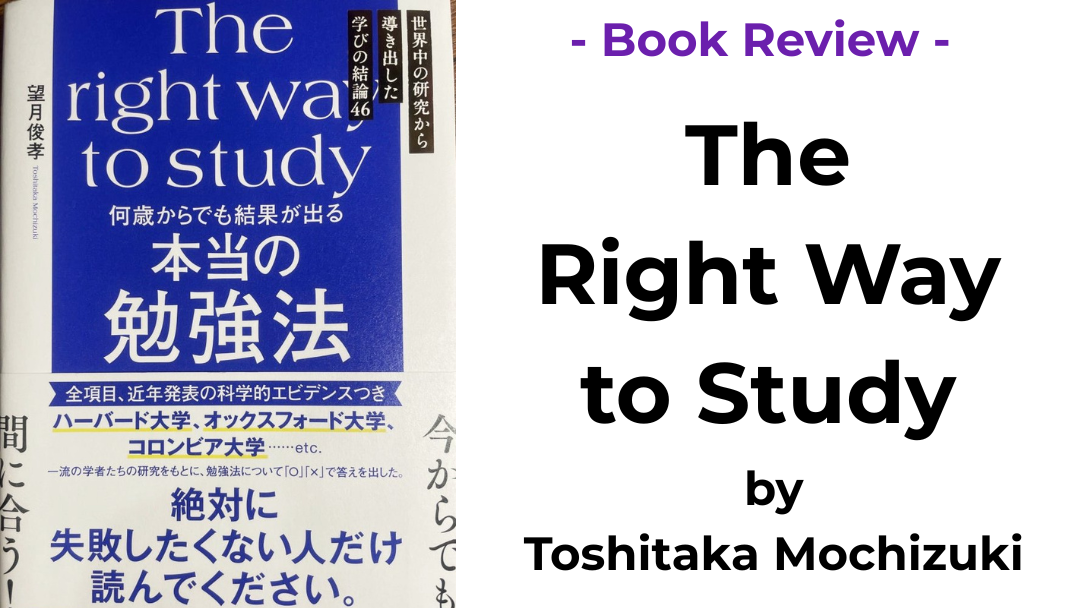
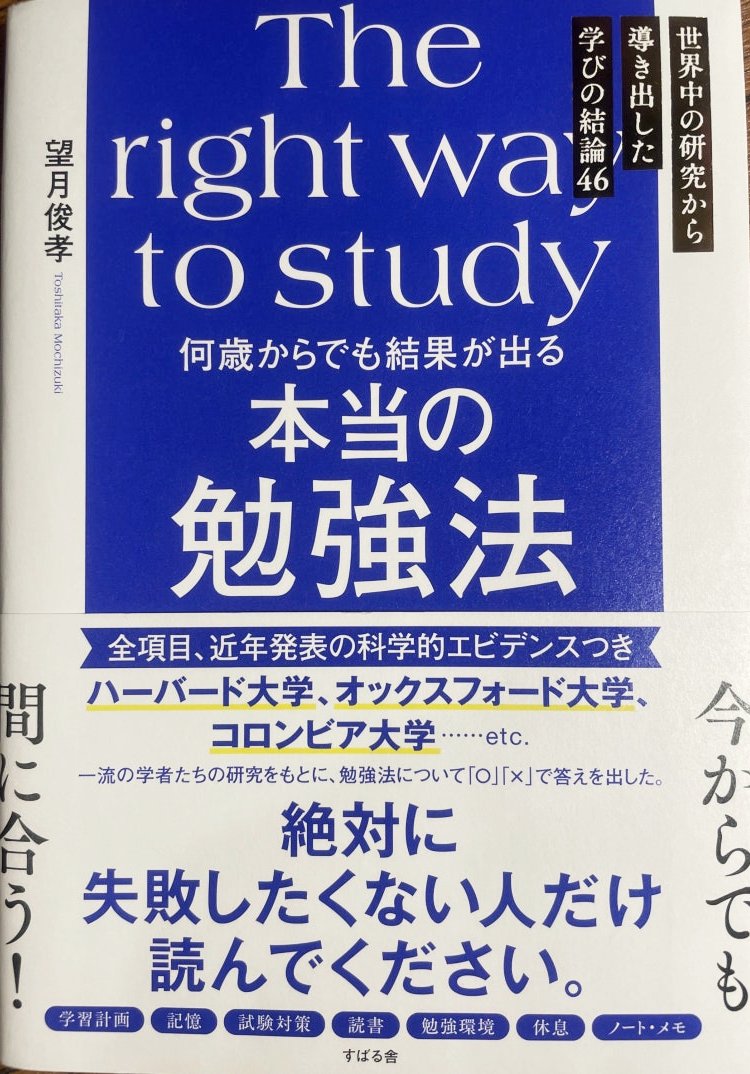
■Title: The Right Way to Study for Results at Any Age (何歳からでも結果が出る 本当の勉強法)
■Author: Toshitaka Mochizuki (望月俊孝)
■Publisher: Subarusha Publishing (すばる舎)
This book is a self-improvement guide that encourages readers to reexamine commonly accepted study methods, under the theme of “a way of studying that produces results at any age.” Based on research from leading institutions such as Harvard, Oxford, and Columbia, it presents 46 study methods in an OX format, allowing readers to clearly understand what truly works. It also covers study planning, exam preparation, reading habits, and rest, offering practical content that can be applied directly to daily life.
The author, Toshitaka Mochizuki, experienced rock bottom in life, going through business failure, heavy debt, health issues, and even layoffs. However, he overcame these hardships and has since taught more than 730,000 people over the past 30 years. Drawing on this experience, the book presents study methods that lead to real results, rather than just theory. It is especially recommended for those who want to avoid failure and are looking for effective ways to study.
Summary
This book presents a step-by-step process for studying that leads to results, targeting a wide range of readers—from students preparing for exams to office workers aiming for career growth, as well as those who want to improve their memory or start learning again after a long break. It first emphasizes the importance of eliminating hesitation and confusion when beginning to study, then setting clear learning goals and creating realistic plans. Through this, it helps readers move away from vague efforts and develop more structured and purposeful study habits.
It then focuses on input methods that produce results regardless of age, explaining how to effectively absorb and retain information. Rather than simply studying more, the book highlights the importance of studying efficiently and developing the habit of objectively evaluating one’s own learning. Finally, it stresses that continuously improving one’s study methods through this process is what ultimately leads to real results.
Notable Quotes
■人は死ぬ間際に「もっと勉強すればよかった」と後悔する
Q:もし、あなたが人生をもう一度やり直せたとしたら、今と違うことをすると思う分野は何ですか?
A:1位 もっと一生懸命教育を受ける(39%)
People regret, at the end of their lives, “I wish I had studied more.”
Q: If you could live your life over again, in which area would you do something differently from now?
A: No.1 To receive a more serious education (39%)
■科学者にとって、「わかりません」は「私に自信があります」と同義語です。
自信がない人間だけが、知っているふりをする必要があるのですから
For scientists, “I don’t know” is synonymous with “I am confident.”
Only those who lack confidence feel the need to pretend they know
My Thoughts
According to the author, true learning begins only when we let go of the word “perfection.” I also tend to pursue perfection in whatever I do, and I realize that I have been more attached to “perfection” than to “completion.” Of course, there were positive aspects to this approach, but by focusing too much on making one thing perfect, there were many cases where my overall progress was slower compared to the same amount of time and effort. That is why this single sentence was very striking to me, as it made me reflect on my entire concept of studying.
The book also emphasizes that learning is not about getting more correct answers, but about discovering and understanding more mistakes. Looking back on my school days, when I was only focused on getting the right answers, it makes me wonder whether that was truly the right way to study.
As the saying goes, “Living beings learn only when their predictions are proven wrong,” I felt that true learning begins not by pursuing a single correct answer, but by forming various hypotheses, testing them, and recognizing what is wrong. If you are looking for a study method that can be applied throughout your life regardless of age, I highly recommend reading this book.
– Recommended Reading –

Amazon Japan The Right Way to Study
Comments